
🚀 The Myth of “Automation Is Complicated” — How One Tutor Automated Scheduling in One Hour
Featured Image Prompt (Viral WordPress Blog Header)
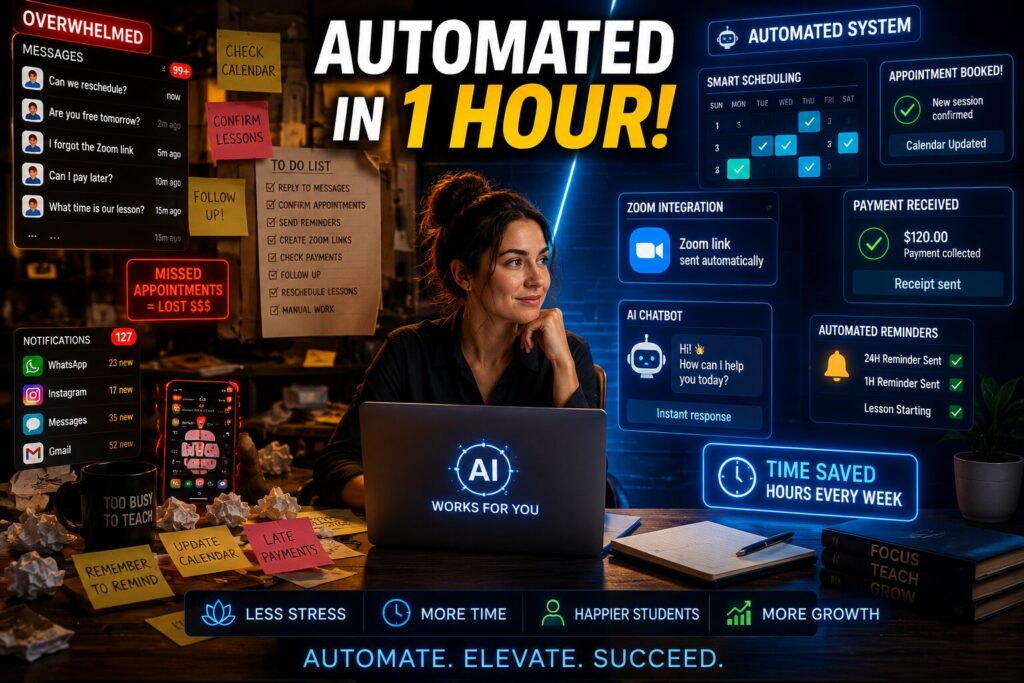
Create a high-contrast ultra-realistic image of a professional female tutor sitting at a modern desk with multiple floating AI automation dashboards around her. One side of the image shows chaos with text messages, sticky notes, missed appointments, and overflowing notifications. The other side shows a clean AI-powered automated scheduling system with glowing calendar integrations, Zoom icons, payment confirmations, and AI chatbot notifications. Include bold modern text that says “AUTOMATED IN 1 HOUR!” with dramatic lighting, cinematic composition, neon blue and orange contrast colors, and modern startup-tech aesthetics. The environment should feel futuristic, fast, and highly productive.
The Myth of “Automation Is Complicated” — How One Tutor Automated Scheduling in One Hour
Most small business owners believe automation is complicated.
That single belief is silently costing businesses thousands of dollars every month in wasted time, operational inefficiency, and lost growth opportunities.
Entrepreneurs everywhere are overwhelmed with repetitive tasks:
- Scheduling appointments
- Sending reminders
- Following up with clients
- Responding to emails
- Managing calendars
- Chasing invoices
- Updating spreadsheets manually
And most of them assume this is simply “part of running a business.”
It is not.
The truth is that modern AI and automation tools have become incredibly simple, affordable, and accessible for small businesses. What used to require developers, enterprise software, and large IT departments can now often be built in less than an hour using no-code tools and AI-driven platforms.
One private tutor recently discovered this firsthand.
And the results completely changed how she operated her business.
The Tutor’s Daily Chaos
The tutor had a growing business.
She was talented, had loyal students, and consistently received referrals. From the outside, everything looked successful.
Behind the scenes, however, operations were a mess.
Every single day involved:
- Back-and-forth text messages
- Students forgetting appointments
- Rescheduling conflicts
- Manual Zoom meeting setup
- Sending reminders individually
- Managing invoices manually
- Chasing late payments
Her phone constantly buzzed with messages like:
- “Are you available tomorrow?”
- “Can we move the lesson?”
- “I forgot the Zoom link.”
- “Can I pay after the session?”
- “Can you remind me again?”
She was spending hours every week on administrative work instead of teaching students.
This is one of the biggest hidden problems affecting small businesses today.
Most entrepreneurs are not overwhelmed because they lack customers.
They are overwhelmed because repetitive tasks are consuming all of their time.
The Real Cost of Manual Work
Small business owners rarely calculate how much manual work actually costs them.
Let’s break it down realistically.
Imagine spending:
- 2 hours daily managing appointments
- 1 hour responding to scheduling questions
- 30 minutes sending reminders
- 30 minutes handling invoices
That equals:
- 4 hours daily
- 20 hours weekly
- 80+ hours monthly
That is essentially two full work weeks every month lost to repetitive administrative tasks.
Now multiply that by:
- Reduced productivity
- Mental exhaustion
- Missed opportunities
- Delayed responses
- Customer frustration
The cost becomes enormous.
Most businesses are unknowingly leaking money through operational inefficiency.
The Biggest Myth About Automation
The phrase “automation is complicated” has stopped millions of businesses from modernizing operations.
Most people imagine automation requires:
- Advanced coding skills
- Expensive software
- Technical expertise
- Enterprise systems
- Large implementation budgets
That may have been true ten years ago.
Today, it is completely different.
Modern automation tools are designed specifically for non-technical users.
Most systems now operate with:
- Drag-and-drop builders
- Prebuilt templates
- AI-generated workflows
- Simple integrations
- Visual automation tools
If you can use social media, you can learn basic business automation.
That is the shift many entrepreneurs still have not realized.
How the Tutor Automated Scheduling in One Hour
The tutor’s automation setup was surprisingly simple.
No developers.
No custom coding.
No expensive consultants.
The system included:
- Online booking software
- Calendar synchronization
- Automated reminders
- Zoom integration
- Payment collection
- AI-powered workflows
Here’s exactly how it worked.
Step 1 — Online Booking Setup
The first step was eliminating manual scheduling conversations.
Instead of texting availability back and forth endlessly, students could simply visit a booking page and choose available time slots.
Immediately:
- Double bookings disappeared
- Scheduling confusion stopped
- Response times improved
- Administrative work decreased
This single change alone removed dozens of repetitive messages weekly.
Step 2 — Automatic Confirmations
The second automation involved instant confirmations.
When a student booked a session:
- Confirmation emails were sent automatically
- Calendar invitations were generated
- Appointment details were synced instantly
No manual confirmation messages were needed anymore.
This dramatically reduced human error and saved additional time.
Step 3 — Automated Reminders
One of the biggest operational improvements came from reminder automation.
Students automatically received:
- 24-hour reminders
- 1-hour reminders
- Session instructions
- Zoom access details
This reduced:
- Missed appointments
- Late arrivals
- Last-minute confusion
Many businesses underestimate how much time they lose simply reminding people manually.
Automation solved this instantly.
Step 4 — Zoom Integration
Before automation, the tutor manually created Zoom links for every session.
This process wasted time daily.
After integration:
- Zoom meetings were automatically generated
- Access links were delivered instantly
- Calendar synchronization handled everything automatically
Another repetitive task disappeared completely.
Step 5 — Payment Automation
Payment collection was another major headache.
Before automation:
- Students paid late
- Invoices were forgotten
- Payment tracking became messy
After automation:
- Payments were collected upfront
- Receipts were automatic
- Financial tracking improved
- Administrative follow-up decreased
This alone improved cash flow significantly.
Why Automation Creates a Competitive Advantage
Most entrepreneurs think automation is about convenience.
It is much bigger than that.
Automation creates speed.
And speed is becoming one of the biggest competitive advantages in modern business.
Today’s customers expect:
- Instant responses
- Easy scheduling
- Fast communication
- Frictionless experiences
Businesses operating manually are becoming slower than customer expectations.
That gap creates risk.
Consumers increasingly choose businesses that are easier to work with.
Automation helps small businesses compete with larger organizations without needing large teams.
AI Changed Everything
The rise of AI has accelerated automation dramatically.
Traditional automation followed fixed rules.
Modern AI-powered systems can now:
- Answer customer questions
- Handle scheduling automatically
- Personalize responses
- Recommend services
- Follow up intelligently
- Manage customer support
This changes everything for small businesses.
A solo entrepreneur today can leverage AI tools previously only available to large corporations.
That is one of the biggest technological shifts happening in business right now.
Why Small Businesses Resist Automation
Despite these advantages, many businesses still avoid automation.
Why?
Fear of Technology
Many entrepreneurs believe they are “not technical enough.”
Modern tools are intentionally designed for non-technical users.
The barrier to entry has dramatically decreased.
Overthinking the Process
Some businesses believe they must automate everything immediately.
Wrong.
Start with one process.
One repetitive task.
Build momentum gradually.
Comfort with Manual Systems
Many entrepreneurs stay attached to inefficient systems simply because they are familiar.
But comfort zones become expensive during technological shifts.
And right now, business technology is changing rapidly.
The Best Tasks to Automate First
Businesses should begin with repetitive operational tasks.
Great starting points include:
- Appointment scheduling
- Lead follow-up
- Reminder notifications
- Customer onboarding
- Payment processing
- FAQ responses
- CRM updates
- Social media posting
- Proposal delivery
The best automation opportunities are usually the tasks you hate repeating daily.
Industries That Benefit Most from Automation
Automation is not limited to tech companies.
Some of the biggest opportunities exist within small service-based businesses.
Examples include:
- Tutors
- Consultants
- Coaches
- Dentists
- Contractors
- Realtors
- Trucking companies
- Medical spas
- Accountants
- Therapists
- Hair salons
- Fitness trainers
These industries often lose enormous amounts of time to repetitive operational work.
The Future of Small Business Operations
The future belongs to lean, technology-enabled businesses.
Not necessarily the largest businesses.
The fastest businesses.
Companies that leverage AI and automation effectively will:
- Scale faster
- Reduce operational costs
- Improve customer experience
- Respond more quickly
- Increase productivity
Over the next five years, businesses operating entirely manually may begin to look outdated.
Just like businesses without websites eventually became outdated.
AI automation is quickly becoming standard business infrastructure.
The Most Important Lesson
The tutor’s story reveals something important.
Automation does not need to be overwhelming.
Most businesses are only one small workflow away from major operational improvements.
One automation can:
- Save hours weekly
- Reduce stress
- Improve customer experience
- Increase revenue
- Create operational consistency
The hardest part is simply starting.
Frequently Asked Questions (FAQ)
Is automation expensive for small businesses?
No. Many automation tools are affordable and often cost less than hiring additional administrative support. Some platforms even offer free starter plans.
Do I need coding skills to automate my business?
No. Most modern automation platforms are designed for non-technical users using drag-and-drop interfaces and templates.
What is the best first business task to automate?
Scheduling, reminders, and customer follow-up are often the easiest and highest-impact starting points.
Can AI automation help solo entrepreneurs?
Absolutely. AI tools can help solo business owners operate more efficiently without hiring large teams.
What tools are commonly used for automation?
Popular tools include:
- Scheduling platforms
- CRM systems
- AI chatbots
- Email automation software
- Payment integrations
- Workflow automation tools
Will automation replace employees?
Automation is primarily designed to eliminate repetitive tasks so people can focus on higher-value work like sales, strategy, and customer relationships.
Final Thoughts
The myth that “automation is complicated” is one of the most expensive beliefs small business owners can hold today.
The tutor automated her scheduling system in one hour.
That one hour:
- Reduced stress
- Improved operations
- Saved time
- Increased efficiency
- Enhanced customer experience
And this is only the beginning.
AI and automation are no longer future technologies.
They are practical tools available right now to entrepreneurs willing to adapt.
The businesses that embrace automation early will build significant competitive advantages over the next decade.
The question is not whether automation matters anymore.
The question is whether your business is ready to evolve before competitors do.
Grow with Technology
🚀 Discover AI tools, automation strategies, and digital growth systems for modern businesses.
🌐 Website: growwithtechnology.com
📺 YouTube: Grow with Technology
🎙️ Spotify Podcast: Grow with Technology
📱 Instagram & Facebook: @growwithtechnology704
#ArtificialIntelligence #Automation #BusinessGrowth #SmallBusiness #AIForBusiness #DigitalTransformation #Productivity #Entrepreneurship #TechInnovation #FutureOfWork