
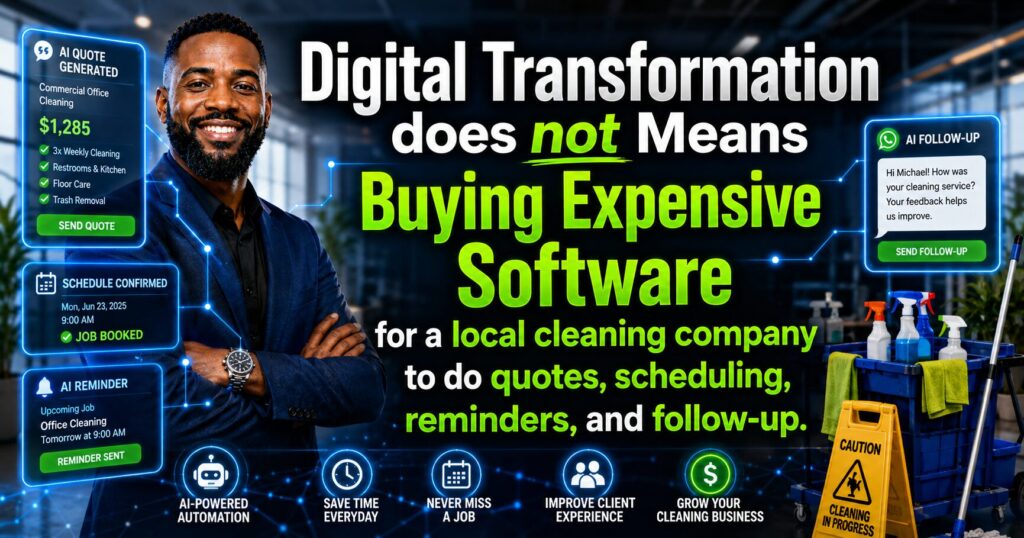
Digital Transformation Does Not Mean Buying Expensive Software for a Local Cleaning Company
Many local cleaning company owners hear the phrase “digital transformation” and immediately think it means buying expensive software.
They imagine complicated dashboards, enterprise platforms, confusing setup calls, high monthly subscriptions, and tools designed for companies with big teams and big budgets.
But that is not what digital transformation should mean for a local cleaning business.
For a residential cleaning company, commercial cleaning company, janitorial service, Airbnb cleaning business, or move-out cleaning service, digital transformation should be simple, practical, and tied directly to revenue.
It should help the business respond faster to quote requests, schedule jobs more easily, send automatic reminders, follow up after service, collect more reviews, and bring customers back for repeat cleanings.
That is real digital transformation.
Not software overload.
Not unnecessary complexity.
Not buying a platform just because everyone says small businesses need “tech.”
A local cleaning company does not need to become a software company.
It needs to become a better, faster, more organized cleaning company.
The goal is simple: more booked jobs, fewer missed leads, better customer communication, and more repeat customers.
The Real Problem Is Not Cleaning. It Is the Workflow.
Most local cleaning companies do not lose business because they are bad at cleaning.
They lose business because the business workflow is messy.
A customer asks for a quote, but the owner is on a job and cannot respond right away.
A homeowner calls during a cleaning appointment, but nobody answers the phone.
A commercial client sends a message about office cleaning, but the message gets buried.
A move-out cleaning lead needs service this weekend, but by the time the company responds, the customer has already booked someone else.
That is not a cleaning problem.
That is a workflow problem.
Many cleaning companies are still managing leads and appointments with phone calls, text messages, paper notes, sticky notes, spreadsheets, Facebook messages, Google Business Profile inquiries, and memory.
That may work in the beginning.
But as the business grows, manual systems start breaking.
The owner becomes the bottleneck.
The team gets confused.
Customers wait too long.
Follow-ups are forgotten.
Reviews are not requested.
Past customers are not contacted again.
Revenue leaks out of the business every single week.
This is where simple digital transformation can help.
The business does not need expensive software first.
It needs a better process first.
Digital Transformation Starts With the Customer Journey
Before buying any tool, a cleaning company should map the customer journey.
That means looking at every step a customer takes from interest to repeat booking.
For most cleaning companies, the journey looks like this:
A customer finds the business online.
They request a quote.
They ask about availability.
They book the service.
They receive appointment confirmation.
They get a reminder before the cleaning.
The cleaning team completes the job.
The customer receives a follow-up message.
The company asks for a review.
The customer receives an offer for recurring service.
That is the journey.
Now here is the question every cleaning company owner should ask:
Where are customers falling through the cracks?
Are quote requests being missed?
Are customers waiting too long for a response?
Is scheduling happening through messy text threads?
Are reminders being sent manually?
Are customers forgetting appointments?
Are follow-up messages being skipped?
Are review requests inconsistent?
Are one-time customers never being offered recurring service?
Those are the places where digital transformation matters.
Not because technology is trendy.
Because missed workflow steps cost money.
Step 1: Automate Quote Requests
The first area a local cleaning company should automate is quote capture.
Speed matters in local service businesses.
When a customer wants a house cleaning, office cleaning, apartment cleaning, Airbnb turnover, move-out cleaning, or deep cleaning, they are often contacting more than one company.
The first professional business to respond usually has a strong advantage.
That does not mean the cleaning company has to send a final price instantly.
But it should acknowledge the customer quickly.
A simple online quote form can collect the important details upfront, including:
Customer name.
Phone number.
Email address.
Service address.
Type of cleaning needed.
Property size.
Number of bedrooms.
Number of bathrooms.
Preferred service date.
Special requests.
Pets in the home.
Photos, if needed.
Frequency requested.
Once the customer submits the form, the system can notify the owner or office manager immediately.
At the same time, the customer can receive an automatic confirmation message.
For example:
“Thank you for requesting a cleaning quote. We received your information and will review your request shortly. We look forward to helping you with your cleaning needs.”
That simple message does a lot.
It tells the customer their request was received.
It makes the company look organized.
It gives the owner the information needed to respond properly.
It prevents leads from disappearing.
And it does not require expensive enterprise software.
This is practical digital transformation.
Step 2: Make Scheduling Easier
Scheduling is one of the biggest sources of chaos in a cleaning business.
A customer says, “Are you available Friday?”
The owner replies, “What time works for you?”
The customer says, “Morning.”
The owner checks the calendar.
The customer disappears.
Then the owner books another job.
Then the customer comes back and says, “Can I still get Friday morning?”
Now the schedule is messy.
This kind of back-and-forth wastes time.
A cleaning company needs a simple scheduling process.
Customers should be able to request a service date and time.
The owner should be able to confirm availability.
The appointment should be saved to a calendar.
The customer should receive confirmation.
The cleaning team should see the job details.
This helps everyone.
For recurring customers, the system can schedule weekly, biweekly, or monthly service.
For commercial cleaning clients, the system can track routine office cleaning.
For Airbnb turnover cleaning, it can help manage fast schedule windows between checkout and check-in.
For move-out cleaning, it can block off more time for bigger jobs.
Better scheduling means fewer mistakes, fewer missed appointments, and less stress.
That is digital transformation working the way it should.
Step 3: Send Automatic Reminders
Cleaning companies lose time and money when customers forget appointments.
Sometimes the customer is not home.
Sometimes pets are not secured.
Sometimes the team cannot access the property.
Sometimes the customer forgot what time the cleaning was scheduled.
Sometimes payment details are unclear.
Automatic reminders help prevent these problems.
A reminder can go out 24 hours before service.
Another reminder can go out the morning of the appointment.
The reminder can include the service time, address, cleaning type, access instructions, pet instructions, and contact information.
Here is an example:
“Hi Lisa, this is a reminder that your deep cleaning service is scheduled for tomorrow at 10:00 AM. Please secure pets, make sure we have access to the home, and let us know if there are any special instructions. Thank you for choosing us.”
That message is simple, but it protects the business.
It reduces confusion.
It helps the customer prepare.
It saves the team from wasted trips.
It makes the company look more professional.
Best of all, the owner does not have to type it manually every time.
This is where automation saves time immediately.
Step 4: Follow Up After Every Job
Most cleaning companies are focused on getting the job.
But the real money is often in what happens after the job is complete.
A customer gets a cleaning service.
The house looks great.
The customer is happy.
Then nothing happens.
No thank-you message.
No review request.
No recurring service offer.
No referral request.
No seasonal cleaning reminder.
That is a missed opportunity.
A cleaning company should follow up after every completed job.
The follow-up should thank the customer, check satisfaction, ask for a review, and offer the next service.
For example:
“Hi Lisa, thank you for choosing us for your cleaning service today. We hope everything looks amazing. If you are happy with the service, would you leave us a quick review? We also offer discounted biweekly and monthly cleaning plans if you would like to stay on schedule.”
That one message can create multiple business outcomes.
It builds goodwill.
It encourages feedback.
It increases reviews.
It creates repeat-service opportunities.
It helps turn one-time customers into recurring customers.
A cleaning company that follows up consistently will often outperform a competitor that only focuses on new leads.
Follow-up is not optional.
Follow-up is where customer retention begins.
Step 5: Ask for Reviews at the Right Time
Reviews are powerful for local cleaning companies.
Customers want to know if they can trust a company inside their home, office, rental unit, or business location.
They want to know if the team shows up on time.
They want to know if the company communicates well.
They want to know if the cleaning quality is consistent.
They want to see proof from other customers.
That is why reviews matter.
But many cleaning companies do not have a review problem.
They have an asking problem.
Happy customers may be willing to leave a review, but they need a reminder.
The best time to ask is shortly after the service is complete.
The customer is looking at the clean space.
The experience is fresh.
The company has delivered value.
That is the right moment.
An automated review request can send customers directly to the company’s Google Business Profile, Facebook page, or review link.
Over time, this can help the business build more trust online.
More reviews can lead to more clicks.
More clicks can lead to more quote requests.
More quote requests can lead to more booked jobs.
That is how a simple review automation becomes part of a local growth strategy.
Step 6: Turn One-Time Jobs Into Repeat Revenue
One-time cleaning jobs are good.
Repeat customers are better.
A one-time deep cleaning customer may pay once.
A biweekly customer pays again and again.
A monthly customer creates predictable revenue.
A commercial cleaning client can become a long-term contract.
An Airbnb host may need cleaning several times a month.
An office may need cleaning every week.
This is why customer follow-up is so important.
A cleaning company should not only ask, “How do we get more new customers?”
It should also ask, “How do we bring existing customers back?”
That means every completed job should trigger a future offer.
A deep cleaning customer can be offered monthly maintenance.
A move-out cleaning customer can be asked for referrals.
A residential customer can be offered a biweekly plan.
An Airbnb owner can be offered turnover packages.
A commercial client can be offered a service agreement.
Digital transformation helps the business stay in touch.
It makes sure customers are not forgotten after one job.
That is how small businesses build long-term value.
AI Can Help Without Replacing People
Artificial intelligence is not here to replace cleaning teams.
AI is not scrubbing floors.
AI is not cleaning kitchens.
AI is not organizing bedrooms.
AI is not walking into homes and building trust with customers.
People still deliver the service.
People still manage quality.
People still represent the brand.
But AI can help with the repetitive administrative work that slows the business down.
AI can help write quote responses.
AI can help draft follow-up messages.
AI can organize customer inquiries.
AI can create review request templates.
AI can suggest seasonal cleaning offers.
AI can help write social media posts.
AI can create cleaning checklists.
AI can help segment customers by service type.
AI can help the owner communicate more professionally and consistently.
This matters because many small business owners are overloaded.
They are cleaning, managing staff, answering calls, handling payments, posting online, sending quotes, and trying to grow.
AI can reduce some of that pressure.
The goal is not to remove the human touch.
The goal is to remove repetitive chaos.
Do Not Buy Software Before Fixing the Process
One of the biggest mistakes small business owners make is buying software before understanding the process.
They sign up for a platform because it has a lot of features.
Then they realize the team does not use most of them.
The owner gets overwhelmed.
The monthly bill keeps coming.
The business is not more organized.
That is not digital transformation.
That is software waste.
A better approach is to identify the business problem first.
Ask:
Where are we losing leads?
Where are we wasting time?
Where are customers waiting too long?
Where are appointments getting confused?
Where are reviews not being requested?
Where are repeat customers not being offered another service?
Where does the owner spend too much manual time?
Once the business understands the problem, it can choose the right tools.
A local cleaning company may only need a quote form, a customer database, a scheduling tool, text reminders, email follow-up, review request automation, and payment links.
That is enough to start.
The best system is not the most expensive system.
The best system is the one the business actually uses.
A Simple Cleaning Company Automation Workflow
Here is what a practical digital workflow can look like:
A customer visits the website.
They click “Request a Quote.”
They fill out the quote form.
The owner receives a lead notification.
The customer receives a confirmation message.
The customer details are saved.
The quote is reviewed and sent.
The customer books a service.
The appointment is added to the calendar.
The customer receives appointment confirmation.
The customer receives a reminder before the appointment.
The cleaning team completes the job.
The customer receives a thank-you message.
The customer receives a review request.
The customer receives a recurring cleaning offer.
The customer is added to future promotions.
That is not complicated.
That is a system.
And systems help businesses grow.
When every lead, appointment, reminder, follow-up, and review request depends on memory, things get missed.
When the system handles the repeatable steps, the owner can focus on quality, sales, staff, and growth.
What Cleaning Companies Should Measure
A cleaning company does not need complicated analytics to get started.
But it should track the numbers that matter.
How many quote requests came in?
How many quotes were sent?
How many quotes turned into bookings?
How many appointments were completed?
How many customers received reminders?
How many customers left reviews?
How many customers booked again?
How many recurring customers were added?
How many leads were lost because of slow response?
These numbers reveal the truth.
They show where the business is growing.
They show where money is leaking.
They show what needs to be improved.
Digital transformation is not only about automation.
It is also about visibility.
When the owner can see what is happening, the owner can make better decisions.
That is how a cleaning company moves from guessing to managing.
Why This Matters for Local Cleaning Companies Now
Customer expectations have changed.
People are used to booking services online.
They expect fast replies.
They expect confirmation messages.
They expect reminders.
They expect convenient payments.
They expect professional communication.
Even if a cleaning company does excellent work, the customer experience can feel outdated if the communication is slow or disorganized.
The customer experience starts before the cleaning team arrives.
It starts with the first message.
The first quote.
The first confirmation.
The first reminder.
The first follow-up.
That experience tells the customer what kind of company they are dealing with.
A company that communicates well feels more trustworthy.
A company that follows up feels more professional.
A company that makes booking easy feels more reliable.
That is why digital transformation matters.
It helps local cleaning companies compete on professionalism, speed, and customer experience.
FAQ: Digital Transformation for Cleaning Companies
What does digital transformation mean for a cleaning company?
Digital transformation means using practical technology to improve how the business handles quotes, scheduling, reminders, customer follow-up, reviews, payments, and repeat bookings. It does not mean buying expensive software just to look modern.
Does a local cleaning company need expensive software to automate?
No. Many cleaning companies can start with affordable tools such as quote forms, scheduling calendars, customer databases, text reminders, email automation, payment links, and review request systems.
What should a cleaning company automate first?
Start with the biggest pain point. If leads are being missed, automate quote requests. If scheduling is messy, automate appointment booking. If customers forget appointments, set up reminders. If repeat business is weak, automate follow-up.
Can AI help a cleaning company?
Yes. AI can help write quote responses, customer follow-up messages, review requests, social media posts, seasonal offers, and customer service replies. AI supports the business, but people still deliver the cleaning service.
How can automation increase revenue for a cleaning company?
Automation can help the company respond faster, book more jobs, reduce no-shows, collect more reviews, and bring past customers back for recurring service. These improvements can lead to more predictable revenue.
Is digital transformation only for large companies?
No. Local cleaning companies can benefit from digital transformation by starting small. The goal is not complexity. The goal is a simple system that saves time, improves communication, and helps the company grow.
Final Thoughts: Keep It Simple and Useful
Digital transformation does not mean buying expensive software.
For a local cleaning company, it means building a simple system that helps the business operate better every day.
Quote requests should be captured quickly.
Scheduling should be organized.
Reminders should be automatic.
Follow-up should happen after every job.
Reviews should be requested consistently.
Repeat customers should be offered future service.
Customer information should be easy to find.
The owner should not have to remember everything manually.
That is the real value of digital transformation.
It reduces chaos.
It saves time.
It improves customer experience.
It creates more opportunities to book jobs and generate repeat revenue.
A local cleaning company does not need to chase every trend.
It needs to fix the workflow.
Start with quotes.
Then scheduling.
Then reminders.
Then follow-up.
Then reviews.
Then recurring customers.
That is how a cleaning company can grow without expensive software, tech headaches, or wasted time.
Call to Action
Want more practical strategies on AI automation, digital transformation, and small business growth?
Subscribe to the Grow with Technology YouTube channel.
Follow @growwithtechnology704 on Instagram and Facebook.
Visit www.growwithtechnology.com for more business technology insights.
Listen to the Grow with Technology podcast on Spotify.
The future of local business belongs to owners who use simple technology to work smarter, serve customers better, and grow with less chaos.
Viral Hashtags
#DigitalTransformation #CleaningBusiness #AIForSmallBusiness #SmallBusinessAutomation #LocalBusinessGrowth #BusinessAutomation #CleaningCompany #AIWorkflow #CustomerExperience #LeadGeneration #ServiceBusiness #CleaningBusinessTips #AIForLocalBusiness #BusinessGrowth #WorkflowAutomation #SmallBusinessTips #CustomerFollowUp #GrowWithTechnology