
Most small businesses do not have a lead problem.
They have a response problem.
Every day, business owners spend money on websites, Google Ads, Facebook Ads, LinkedIn content, email marketing, SEO, social media posts, landing pages, referrals, and paid campaigns. The goal is simple: get more people interested in their product or service.
But here is the painful truth.
Many businesses are already getting leads.
The problem is that they are not responding fast enough.
A potential customer fills out a form. Someone sends a direct message asking for pricing. A buyer calls after seeing an ad. A prospect downloads a guide. A homeowner requests a quote. A business owner schedules a consultation request.
At that exact moment, the lead is hot.
They are paying attention. They have a problem. They are looking for a solution. They are ready to take the next step.
Then the business waits.
Five minutes becomes thirty minutes. Thirty minutes becomes three hours. Three hours becomes tomorrow. By the time someone finally responds, that lead has already moved on, called a competitor, booked somewhere else, or completely lost interest.
That is how money disappears.
Not because the business did not generate the lead.
Not because the lead was fake.
Not because the offer was bad.
But because the response system was too slow.
This is where artificial intelligence becomes one of the most powerful tools for small business growth.
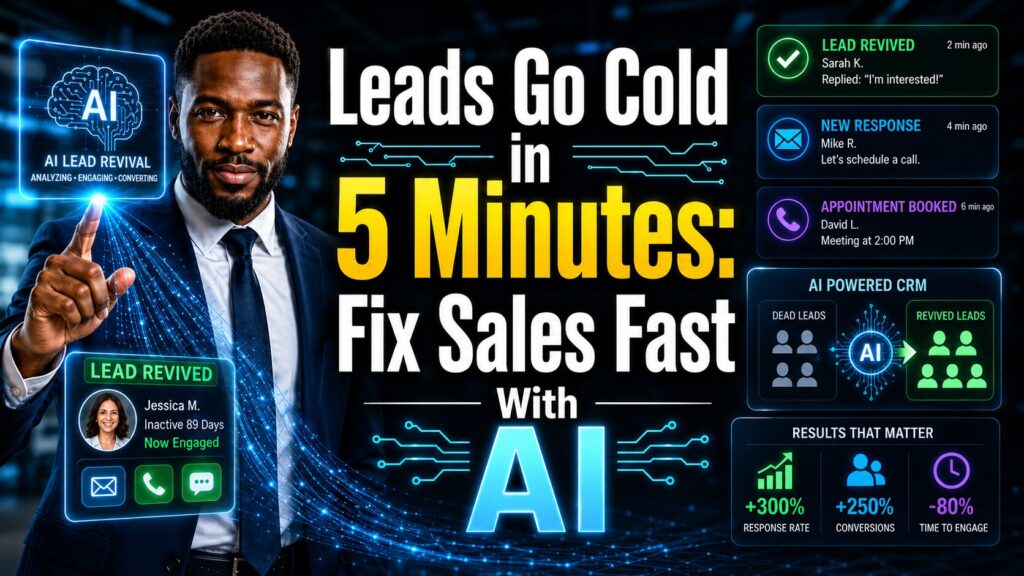
AI can respond instantly, qualify leads, answer common questions, book appointments, trigger follow-ups, update your CRM, notify your team, and keep prospects engaged before they go cold.
This is not about replacing your employees.
This is about replacing the repetitive chaos that causes leads to slip through the cracks.
Why Leads Go Cold So Fast
Modern buyers move quickly.
They do not wait around for one business to respond. They search, compare, click, call, message, and move on. If they need a plumber, they contact three companies. If they need a lawyer, they submit more than one form. If they want a medical spa appointment, they message multiple providers. If they need a contractor, they ask for several estimates.
The business that responds first often controls the conversation.
That does not always mean the fastest company is the best company. But in the mind of the customer, speed creates confidence.
A fast response says:
“We are available.”
“We are professional.”
“We are organized.”
“We care about your problem.”
A slow response says the opposite.
It creates doubt.
The customer starts wondering if your business is too busy, too disorganized, or simply not interested. Even if that is not true, perception matters. In sales, perception can decide whether the lead becomes a customer or disappears forever.
This is why the first five minutes matter so much.
The first five minutes are not just about speed. They are about attention, trust, and momentum.
When a customer reaches out, they are in action mode. They are thinking about the problem right now. They are looking for an answer right now. They are most likely to engage right now.
If your business does not respond during that window, the lead starts cooling down.
The Hidden Revenue Leak in Small Businesses
Most small businesses focus heavily on getting more leads.
More traffic.
More ads.
More posts.
More visibility.
More referrals.
More campaigns.
But very few stop to ask this question:
What happens after the lead comes in?
That is where the real problem usually lives.
Leads get lost in email inboxes. They sit inside website forms nobody checks. They disappear in Facebook Messenger. They get buried in Instagram DMs. They go to voicemail. They sit inside spreadsheets. They get assigned to someone who is already too busy. They wait for a callback that never comes.
This is not a marketing problem.
This is an operations problem.
A business can have a great website, strong content, a good offer, and a steady flow of leads. But if the follow-up process is slow or inconsistent, revenue leaks out of the business every single day.
The painful part is that many of these leads were already paid for.
You paid for the ad click.
You paid for the website.
You paid for the marketing agency.
You paid for the SEO campaign.
You paid for the landing page.
Then the lead came in, and nobody responded fast enough.
That is like buying inventory and leaving it outside in the rain.
AI fixes this by creating an instant response layer between your business and the customer.
How Artificial Intelligence Fixes Slow Lead Response
Artificial intelligence gives small businesses something they could not easily afford before: 24/7 lead response.
An AI-powered lead response system can work while your staff is busy, after your office is closed, during weekends, during lunch breaks, and even when you are asleep.
The system can respond within seconds.
It can greet the lead, ask what they need, collect key information, answer common questions, offer appointment times, send reminders, and notify a human when the lead is ready for personal attention.
That is powerful.
AI does not replace the human relationship. It protects the opportunity until a human can step in.
For example, instead of a website form sitting in an inbox for two hours, AI can send an instant text:
“Thanks for reaching out. I can help you get started. Are you looking for pricing, availability, or a consultation?”
That simple message does three things.
First, it acknowledges the customer immediately.
Second, it keeps the conversation alive.
Third, it moves the lead toward the next step.
That is the difference between a cold lead and a booked call.
What an AI Lead Response System Should Do
A strong AI lead response system is more than a chatbot.
A basic chatbot that says “How can I help you?” is not enough. A real system should connect your lead sources, messaging, calendar, CRM, and sales process.
Here is what the system should do.
It should capture every lead from your website, landing pages, social media, ads, missed calls, chat, and email.
It should send an instant response by text, email, chat, or voice.
It should ask basic qualifying questions.
It should collect the customer’s name, phone number, email, location, service need, timeline, and budget range when appropriate.
It should route the lead to the correct person.
It should offer available appointment times.
It should book consultations, estimates, calls, or service appointments.
It should send reminders before the appointment.
It should follow up when the lead does not respond.
It should update your CRM automatically.
It should notify your team when a hot lead needs attention.
That is how AI turns lead response from a manual guessing game into a predictable revenue system.
Real Example: A Contractor Losing Quote Requests
Imagine a local remodeling contractor running Google Ads.
A homeowner fills out a form asking for a kitchen remodel estimate.
Without AI, the form goes to an email inbox. The office manager is busy. The estimator is on a job site. Nobody responds for three hours.
By then, the homeowner has already booked a consultation with another contractor.
Now imagine the same business with AI.
The moment the form is submitted, the homeowner receives a text:
“Thanks for requesting a kitchen remodel estimate. What city are you located in, and when are you hoping to start the project?”
The AI collects the project type, location, budget range, and timeline. Then it offers available consultation times and books the appointment.
The contractor gets a notification with all the details.
That lead did not go cold.
That lead became a scheduled opportunity.
The ad spend did not get wasted.
Real Example: A Law Firm Missing Intake Leads
Law firms lose high-value leads every day because intake is too slow.
A potential client may be dealing with an accident, immigration issue, family matter, business dispute, or criminal defense concern. They are stressed. They want answers. They contact multiple law firms.
If your firm responds tomorrow, the prospect may already have a consultation booked with someone else.
AI can help by acting as a first-line intake assistant.
It can respond instantly, collect the case type, location, urgency, contact details, and preferred consultation time. It can avoid giving legal advice while still guiding the prospect to the correct next step.
The AI might say:
“Thanks for contacting us. I can help route your inquiry. What type of legal matter do you need help with?”
Then it can schedule a consultation and alert the intake team.
This makes the law firm faster, more organized, and more responsive without overloading staff.
Real Example: A Medical Spa Losing Instagram Leads
Medical spas often generate interest from Instagram, Facebook, and TikTok. Someone sees a post about Botox, facials, laser treatments, body contouring, or skin care and sends a message asking for pricing.
If nobody responds quickly, the person keeps scrolling.
AI can instantly respond to the DM, ask what treatment the person is interested in, share approved information, offer a consultation, and send a booking link.
The AI might say:
“Thanks for reaching out. Are you interested in Botox, facials, skin tightening, laser treatment, or a consultation?”
That instant response keeps the lead engaged.
The business does not lose the customer just because the front desk was busy.
Why AI Follow-Up Converts Better
The first response is important, but follow-up is where many sales are won.
Most small businesses follow up once, maybe twice, and then stop.
AI can follow up consistently without relying on memory.
A smart follow-up sequence might look like this:
Immediate response.
Five-minute reminder if there is no reply.
One-hour follow-up.
Next-day follow-up.
Three-day check-in.
Seven-day reminder.
Final message asking if the request should stay open.
The key is to make the follow-up helpful, not annoying.
For example:
“Just checking in. Are you still looking for help with this, or should I close this request for now?”
That message works because it is simple, direct, and respectful.
AI can also personalize follow-up based on the customer’s original request.
A remodeling lead should not receive the same message as a dental patient. A law firm lead should not receive the same follow-up as a fitness studio prospect. Personalization matters.
The Money Math: Why Speed-to-Lead Matters
AI lead response is not just about convenience.
It affects revenue.
Let’s say your business spends $3,000 per month on marketing and generates 100 leads.
If your current conversion rate is 10%, you get 10 customers.
Now imagine AI helps you respond faster, follow up better, and increase conversions to 15%.
That gives you 15 customers from the same ad spend.
If each customer is worth $1,000, that is an extra $5,000 in revenue.
If each customer is worth $5,000, that is an extra $25,000 in revenue.
If each customer is worth $10,000, that is an extra $50,000 in revenue.
This is why AI lead response is one of the highest-impact automations a small business can install.
You are not trying to create more work.
You are trying to convert more of the opportunities you already paid for.
The Best AI Lead Response Workflow
Here is a simple workflow any small business can use.
First, connect your website forms, landing pages, missed calls, social media messages, and ad leads to one central system.
Second, trigger an instant text or email response when a new lead arrives.
Third, ask one to three qualifying questions.
Fourth, offer the next step, such as booking a call, scheduling an estimate, requesting a consultation, or speaking with a specialist.
Fifth, update your CRM automatically.
Sixth, notify your team when the lead is ready.
Seventh, send reminders and follow-ups until there is a clear outcome.
This workflow is simple, but it can transform your business.
The goal is not to make AI complicated.
The goal is to make response fast, consistent, and measurable.
Common Mistakes to Avoid
Do not rely only on email. Many customers respond faster to text, chat, or phone.
Do not wait for a human to send the first message. Let AI open the conversation immediately.
Do not make the AI sound robotic. Train it with your brand voice and approved responses.
Do not ask too many questions upfront. Keep the first interaction simple.
Do not let AI give legal, medical, or financial advice unless it is properly controlled and compliant.
Do not forget the human handoff. AI should support your team, not trap customers in automation.
Do not run AI without tracking results. Measure response time, booked calls, show-up rates, and conversion rates.
The purpose of AI is not to add more tools.
The purpose is to create a better system.
Best Businesses for AI Lead Response
AI lead response works especially well for businesses that depend on inbound inquiries.
This includes contractors, plumbers, electricians, HVAC companies, roofers, landscapers, cleaning companies, law firms, dental offices, medical spas, real estate agents, consultants, coaches, recruiting agencies, fitness studios, insurance agencies, financial service firms, and local service businesses.
Any business that receives website forms, phone calls, DMs, quote requests, or consultation requests can benefit.
The reason is simple.
When people reach out, timing matters.
If your competitor responds before you, they may win the conversation before you even know the lead arrived.
FAQ: AI Lead Response for Small Businesses
1. Why do leads go cold so quickly?
Leads go cold because customer attention moves fast. When someone reaches out, they are usually comparing options. If your business does not respond quickly, they may contact a competitor, lose interest, or forget why they reached out.
2. Can AI really help convert more leads?
Yes. AI can help by responding instantly, asking qualifying questions, sending follow-ups, booking appointments, and notifying your team. This improves speed, consistency, and customer experience.
3. Does AI replace my sales team?
No. AI should not replace your sales team. It should support them by handling the first response, collecting basic information, and keeping leads engaged until a human can step in.
4. What is the best first AI automation for lead response?
The best first automation is an instant response workflow. When a lead submits a form, calls, or sends a message, AI should immediately reply, ask what they need, and guide them to the next step.
5. Should AI use text, email, chat, or voice?
The best system often uses more than one channel. Text is great for speed. Email is useful for details. Chat works well on websites. Voice AI can help with missed calls and appointment scheduling.
6. Is AI lead response expensive?
It does not have to be. Many small businesses can start with simple tools connected to their website, CRM, calendar, and SMS platform. The key is to start small and improve over time.
7. What if the AI gives the wrong answer?
That is why AI must be trained with approved business information, FAQs, service details, pricing rules, and escalation instructions. The system should also know when to hand off to a human.
8. Which industries benefit most?
Home services, legal, healthcare, dental, real estate, consulting, recruiting, wellness, fitness, insurance, and local service businesses benefit strongly because they depend on fast lead response.
Final Thoughts: The First Five Minutes Matter
Your business may not need more leads.
It may need a better response system.
If you are paying for marketing but responding slowly, you are leaking revenue. If leads are sitting in inboxes, voicemail, DMs, or spreadsheets, your business is losing opportunities that may never come back.
Artificial intelligence fixes this by giving your business a faster, smarter, and more consistent way to engage prospects.
AI can respond instantly.
AI can qualify leads.
AI can book appointments.
AI can follow up.
AI can alert your team.
AI can update your CRM.
Most importantly, AI can help make sure no lead gets ignored during the most important moment: the moment they are ready to buy.
The businesses that win today are not always the ones with the biggest ad budgets.
They are the ones that respond first, follow up better, and make it easier for customers to say yes.
So if your leads are going cold, stop blaming the lead source first.
Look at your response system.
Your marketing may be working.
Your website may be working.
Your ads may be working.
But your follow-up may be failing.
That is where AI can change everything.
Respond faster. Qualify smarter. Book sooner. Follow up better. Convert more of the leads you already have.
That is the fix.
Call to Action
Want more practical strategies on using artificial intelligence to grow your business?
Subscribe to the Grow with Technology YouTube channel, follow @growwithtechnology704 on Instagram and Facebook, visit www.growwithtechnology.com, and listen to the Grow with Technology podcast on Spotify.