
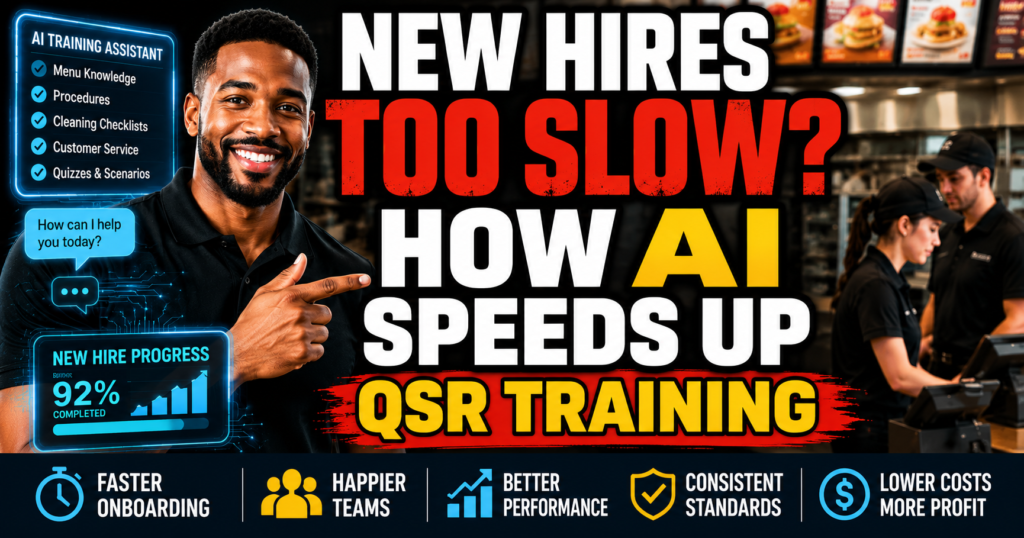
Hiring a new employee should solve a staffing problem. But for many quick-service restaurant franchise owners, hiring creates another challenge almost immediately:
How do you get that new employee trained, confident, and productive as quickly as possible?
A new quick-service restaurant employee may need to learn menu items, food preparation procedures, cleaning checklists, customer service standards, opening and closing responsibilities, point-of-sale processes, mobile orders, drive-through procedures, and dozens of other operational details.
Meanwhile, the restaurant doesn’t stop.
Customers still expect fast service. Orders still need to be accurate. Food quality must remain consistent. Managers need to supervise employees, control labor, manage inventory, solve customer problems, and keep the shift moving.
That creates an operational bottleneck.
Your managers become trainers while they’re trying to manage the restaurant.
Your experienced employees become walking instruction manuals.
Your new employees repeatedly stop working to find someone who can answer a question.
And when turnover happens, the process starts all over again.
Artificial intelligence provides quick-service restaurant operators with an opportunity to rethink this process.
Instead of using AI to replace employees, restaurants can use it to help employees learn faster and give managers more time to manage.
The result could be a more scalable employee training model—especially for franchise operators managing multiple locations.
The Hidden Business Cost of Slow Employee Training
Most restaurant owners understand that training costs money.
But the true cost isn’t limited to the hours you’re paying a new employee while they learn.
There is also the time of the person doing the training.
Imagine a new employee asking:
“What’s on my closing checklist?”
A manager stops and explains it.
A few minutes later:
“How do I process this type of order?”
The manager answers.
Then:
“How should I handle this customer complaint?”
Another explanation.
Later:
“Where does this product go?”
Another interruption.
None of these questions are unreasonable.
New employees are supposed to ask questions.
The operational problem is that many of those questions involve information the company already has documented somewhere.
The answer might be inside an employee handbook.
It might be buried in an operations manual.
It might exist inside a learning management system.
It might be printed on a checklist.
Or it might exist only in the head of an experienced manager.
The employee simply can’t access the information quickly enough.
That turns experienced managers into human search engines.
Multiply those interruptions across several new employees, multiple shifts, and several restaurant locations, and training becomes a significant drain on management capacity.
The Problem Isn’t Your New Employee
It’s easy to look at a struggling new hire and think:
“They aren’t learning fast enough.”
But sometimes the problem isn’t the employee.
The problem is the training system.
Traditional restaurant onboarding often attempts to transfer an enormous amount of information in a very short period.
Employees may watch training videos.
Read manuals.
Shadow another employee.
Complete orientation.
Receive verbal instructions.
Then they’re expected to remember everything while working inside a fast-moving restaurant.
That’s difficult.
Especially when employees are learning several things simultaneously.
AI introduces another approach.
Instead of expecting an employee to memorize everything during orientation, businesses can give employees an intelligent way to access approved information when they actually need it.
What Is an AI Employee Training Assistant?
An AI employee training assistant is essentially an intelligent interface between an employee and the restaurant’s approved knowledge.
Instead of searching through a large training manual, an employee could ask a question naturally.
For example:
“What are my opening responsibilities?”
The system retrieves the relevant approved procedure.
The employee asks:
“Quiz me on our menu.”
The system creates a learning exercise based on approved menu information.
The employee asks:
“What should I do when a customer says their order is wrong?”
The system provides guidance based on the restaurant’s approved customer service procedures.
The key word here is approved.
This should not be a random public AI chatbot improvising restaurant policies.
The AI system should be grounded in the organization’s authorized training materials, policies, procedures, and knowledge base.
AI becomes the interface.
Your business remains the source of truth.
1. Use AI to Accelerate Menu Training
Menu knowledge is one of the most obvious QSR training opportunities.
New employees may need to understand:
- Menu categories and products
- Ingredients
- Available modifications
- Current promotions
- Preparation standards
- Packaging requirements
- Common customer questions
Instead of simply asking employees to study this information, AI can turn menu learning into an interactive experience.
An employee could say:
“Give me a 10-question menu quiz.”
The AI generates questions based on approved information.
The employee answers.
The AI provides feedback.
Then it adjusts future questions based on the areas where the employee needs more practice.
That turns passive learning into active learning.
It can also make training more personalized.
One employee might need additional help learning menu combinations.
Another may need more practice with customer questions.
AI can support both without requiring a manager to manually create a different lesson every time.
2. Turn Restaurant Procedures Into On-Demand Knowledge
Consider how many standard operating procedures exist inside a restaurant.
Opening procedures.
Closing procedures.
Station preparation.
Restocking.
Order handling.
Cleaning.
Shift changes.
Inventory processes.
Customer service procedures.
New employees aren’t going to remember every procedure immediately.
With an AI-supported knowledge system, they don’t necessarily have to.
They need to know the fundamentals, understand their responsibilities, and know where to find the approved information when they need additional guidance.
This is an important shift.
The goal isn’t simply:
Memorize everything.
The goal becomes:
Learn the job and know how to access the right information quickly.
3. Make Cleaning Checklists Easier to Follow
Cleaning is another area where consistency matters.
Restaurants may have tasks that need to happen at opening, throughout the shift, during transitions, and at closing.
Instead of relying entirely on memory, employees could access approved digital checklists.
The AI assistant could help an employee understand which checklist applies to their role or shift.
For example:
“Show me the approved closing checklist for my station.”
The employee receives the relevant information.
If a procedure involves chemicals, specialized equipment, safety requirements, or regulatory obligations, the system should provide only approved guidance and escalate when necessary.
AI should reinforce your cleaning system.
It shouldn’t invent one.
4. Practice Customer Service Before Facing Real Customers
Customer service is difficult to teach from a manual.
You can tell employees:
“Stay calm.”
“Listen to the customer.”
“Follow our service recovery process.”
But what happens when a frustrated customer is standing in front of them?
AI creates an interesting opportunity for role-playing.
The system could present a scenario:
“A customer says they received the wrong order and they’re frustrated. How would you respond?”
The employee responds.
The AI evaluates the response against approved customer service principles and offers feedback.
Then the scenario becomes slightly more difficult.
A mobile order is missing.
A drive-through customer complains about the wait.
A customer requests something the employee doesn’t have authority to approve.
Employees can practice these situations before experiencing them during a busy shift.
Managers can then focus on coaching rather than creating every scenario manually.
5. Use AI for Micro-Learning
One of the biggest problems with traditional training is information overload.
Imagine trying to learn dozens of restaurant procedures during your first few days.
AI makes micro-learning easier.
Instead of one enormous training session, employees can receive small learning experiences throughout their onboarding.
For example:
Monday: Five-minute menu quiz.
Tuesday: Customer service scenario.
Wednesday: Cleaning procedure review.
Thursday: Opening checklist exercise.
Friday: Short knowledge assessment.
These small interactions reinforce knowledge over time.
Training becomes a process instead of an event.
AI Can Give Restaurant Managers Time Back
This may be the most important business benefit.
Your restaurant manager should be managing.
That means:
Leading employees.
Monitoring service.
Solving problems.
Managing labor.
Coaching team members.
Maintaining standards.
Watching customer experience.
Managing inventory.
Preparing for rush periods.
A manager’s highest-value contribution probably isn’t answering the same basic question 30 times.
AI can potentially handle some of that repetitive information retrieval.
The manager then becomes the coach and decision-maker instead of the human FAQ system.
That’s an important distinction.
The objective isn’t to remove managers.
It’s to increase the value of their time.
AI Should Support Humans, Not Replace Them
There’s a tendency to frame every AI conversation around job replacement.
For employee training, that misses the larger opportunity.
Great managers do things AI cannot replicate effectively.
They motivate people.
They recognize when someone is struggling.
They build relationships.
They understand context.
They resolve unusual problems.
They establish culture.
They exercise judgment.
An AI assistant can retrieve information quickly.
That doesn’t make it a restaurant manager.
The strongest model combines both.
AI handles repetitive information.
Humans handle leadership, judgment, accountability, and relationships.
Food Safety and High-Risk Situations Require Guardrails
Restaurant operators must also understand where AI should stop.
Food safety cannot depend on an AI system improvising answers.
Neither should allergen concerns, employee injuries, serious equipment problems, workplace harassment, emergencies, or other high-risk situations.
Your AI training assistant should contain escalation rules.
For example, if an employee asks about a potential allergen issue, the system might direct the employee to stop and immediately contact the appropriate manager while following the company’s approved allergen procedure.
Similar escalation rules should exist for:
- Food safety incidents
- Employee injuries
- Equipment malfunctions
- Serious customer incidents
- Workplace complaints
- Emergencies
- Situations outside the employee’s authority
Responsible AI doesn’t mean allowing technology to answer everything.
Sometimes the correct AI response is:
“This requires your manager.”
Multi-Location Franchise Operators Have an Even Bigger Opportunity
Now imagine this approach across multiple restaurant locations.
Without a standardized system, employee training can vary significantly.
One manager may be an excellent trainer.
Another may be inconsistent.
One location follows the training program closely.
Another develops informal shortcuts.
A centralized AI-supported knowledge system can help establish a common foundation.
Employees at different locations can access the same approved information.
Updated procedures can be incorporated into the central knowledge system.
New employees can receive similar foundational learning experiences.
Managers still adapt coaching to the individual employee, but the underlying information becomes more consistent.
For growing franchise organizations, this can turn AI from a simple productivity tool into scalable operational infrastructure.
How to Start AI-Powered QSR Training
Don’t begin by trying to automate your entire training department.
Start small.
Step 1: Identify Repetitive Questions
Ask your managers and shift leaders:
“What questions do new employees ask us repeatedly?”
Write down the answers.
You may discover that a relatively small number of questions create a large percentage of interruptions.
Step 2: Collect Approved Information
Gather the documents containing the correct answers.
This might include:
- Employee training materials
- Menu information
- Standard operating procedures
- Opening and closing checklists
- Cleaning procedures
- Customer service guidelines
- Approved FAQs
- Franchise operating documentation
Make sure the information is current and authorized for use.
Step 3: Clean Up Your Knowledge
AI won’t magically fix bad documentation.
If three documents provide three different answers to the same question, that’s a business process problem.
Resolve outdated or conflicting information before implementing AI.
Step 4: Create a Limited Pilot
Choose one restaurant.
Choose one department or training area.
Choose a small group of employees.
You might start with:
Menu knowledge + customer service FAQs + opening and closing procedures.
Test that before expanding.
Step 5: Establish Human Escalation
Clearly identify questions the AI assistant should not handle independently.
Employees need to understand when to stop using the system and contact a manager.
Step 6: Measure Results
This is where AI becomes a business strategy instead of a technology experiment.
Track metrics such as:
- Time from hire to basic competency
- Manager training hours per new employee
- Training completion
- Menu knowledge scores
- Repetitive employee questions
- Procedure-related errors
- Early employee retention
- Customer service indicators
Compare performance before and after your pilot.
Don’t Buy AI Until You Identify the Business Problem
This principle extends far beyond restaurants.
Businesses frequently start their AI journey by asking:
“Which AI tool should we buy?”
That’s backwards.
Start by asking:
“Where are we losing time?”
Where are managers repeating themselves?
Where do employees struggle to find information?
Where do mistakes happen repeatedly?
Where does the organization depend too heavily on knowledge stored inside one person’s head?
Where are customers waiting because employees don’t have the information they need?
Once you’ve identified the friction, you can determine whether AI is the appropriate solution.
Business problem first. Technology second.
The Real Future of QSR Training
The future of restaurant training isn’t about eliminating people.
It’s about creating better systems around people.
Imagine a new employee entering your restaurant and receiving human orientation from a manager.
They’re welcomed to the team.
They learn the culture.
They understand their responsibilities.
They receive safety training.
Then they gain access to an AI-supported learning resource.
During the week, they practice menu knowledge.
They complete customer service scenarios.
They review procedures.
They ask basic questions.
The AI reinforces approved information.
The manager watches their progress and focuses on areas requiring human coaching.
That’s a fundamentally different model from:
“Here’s the manual. Shadow someone for a few shifts. Good luck.”
The employee gets technology.
The manager gets time.
The restaurant gets greater consistency.
And the customer gets an employee who may be better prepared to provide the experience the brand expects.
Frequently Asked Questions About AI for QSR Training
Will AI replace restaurant managers?
No. AI training systems are better positioned to support managers by handling repetitive information retrieval, basic knowledge reinforcement, quizzes, and practice scenarios. Managers remain essential for leadership, coaching, safety, accountability, culture, and decision-making.
Can a small restaurant use AI employee training?
Yes. AI-supported training doesn’t have to begin as a large enterprise project. A restaurant can start with a narrow pilot focused on FAQs, menu knowledge, or approved opening and closing procedures before deciding whether expansion makes business sense.
What information can an AI restaurant training assistant use?
Depending on the system, approved information might include menu knowledge, customer service standards, employee FAQs, standard operating procedures, cleaning checklists, and opening and closing procedures. Businesses should carefully control which documents are approved for the system.
Can AI train employees on food safety?
AI may help employees access approved food safety training information, but restaurants should not rely on generative AI to improvise safety instructions. Food safety programs should follow applicable regulations, approved company policies, required training, and qualified human oversight.
How can AI help with customer service training?
AI can create role-playing exercises based on approved service standards. Employees can practice responding to common customer situations and receive feedback before encountering similar scenarios during an actual shift.
How do I know whether AI training is working?
Measure operational outcomes. Compare time to competency, manager training hours, training completion, knowledge assessments, procedure errors, repetitive questions, retention, and relevant customer service indicators before and after implementation.
Can AI training work across multiple franchise locations?
Potentially, yes. A centrally managed knowledge system can help provide employees across multiple locations with access to consistent approved information. Individual franchise agreements, corporate policies, local requirements, and permissions should still be respected.
Should employees use public AI tools for restaurant procedures?
Restaurants should be cautious about employees entering proprietary, personal, customer, or sensitive company information into unapproved public AI systems. Businesses should establish clear AI usage policies and determine which tools and information sources employees are authorized to use.
Final Thoughts: Train Smarter, Not Just Harder
Quick-service restaurants don’t necessarily need more training.
They need more efficient training systems.
Your best managers shouldn’t spend their entire day functioning as human search engines.
Your new employees shouldn’t have to choose between interrupting a busy manager and guessing.
And franchise operators shouldn’t have to rebuild institutional knowledge every time an experienced employee leaves.
AI creates an opportunity to change that.
Use AI to make approved information easier to access.
Use AI to reinforce learning.
Use AI to create practice scenarios.
Use AI to reduce repetitive questions.
But keep humans responsible for leadership, safety, judgment, coaching, and culture.
That’s the real opportunity.
The question isn’t:
“Can AI replace restaurant employees?”
The better question is:
“Can AI help our employees become productive faster while giving our managers more time to lead?”
For many quick-service restaurant operators, that question may be worth answering now.
Ready to Grow Your Business With Technology?
If you’re a restaurant owner, franchise operator, entrepreneur, or small business leader looking for practical ways to use AI, automation, and digital transformation to improve operations and grow revenue, follow Grow with Technology.
Subscribe to the Grow with Technology YouTube channel for practical AI and business technology strategies.
Follow @growwithtechnology704 on Instagram and Facebook.
Visit GrowWithTechnology.com for more business technology insights and resources.
Listen to the Grow with Technology podcast on Spotify for conversations about AI, automation, digital transformation, productivity, and the future of business.
Use technology to remove repetitive work. Keep humans in control. And Grow with Technology.
#ArtificialIntelligence #RestaurantTechnology #QSR #RestaurantManagement #AITraining #EmployeeTraining #EmployeeOnboarding #FranchiseBusiness #BusinessAutomation #DigitalTransformation #SmallBusinessAI #RestaurantIndustry #FutureOfWork #FranchiseOwners #GrowWithTechnology