
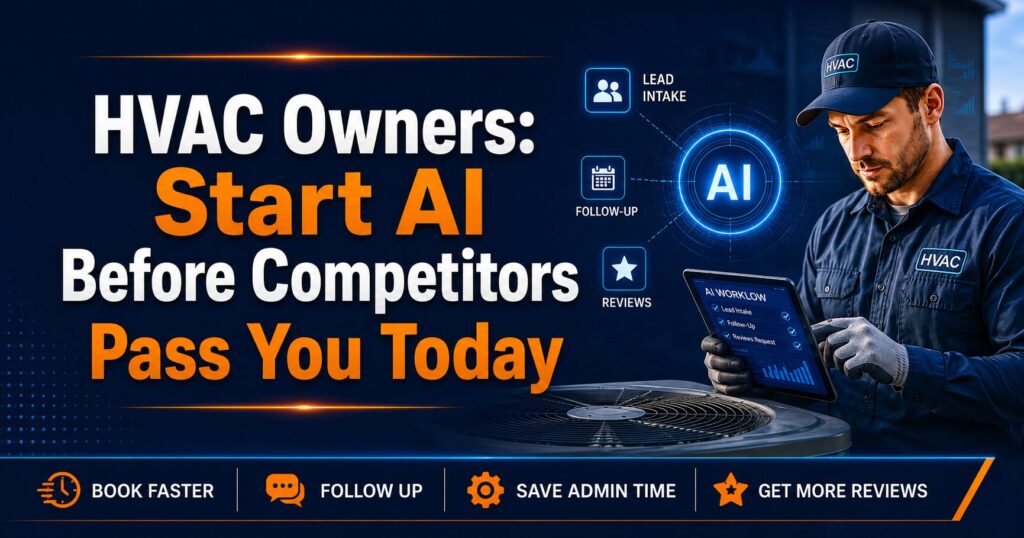
HVAC Company Owners Cannot Afford to Wait on AI
Most HVAC company owners are not against AI. They are just confused about where to start.
They hear about artificial intelligence every day. They see competitors using chatbots, automated follow-ups, online booking, review requests, smart dispatching, and AI-generated marketing. But when it comes time to implement AI inside their own HVAC business, many owners freeze.
Not because they are lazy.
Not because they do not want to grow.
Not because they do not understand technology.
They freeze because AI sounds complicated. It sounds expensive. It sounds like something only big companies with big budgets can afford.
That is the wrong way to look at it.
AI is not just for national HVAC brands. AI is now practical for local HVAC companies, family-owned contractors, and growing service businesses that want to save time, book more jobs, reduce missed opportunities, and operate with less chaos.
The HVAC company that learns how to use AI for simple business operations will move faster than the company still doing everything manually. That does not mean AI replaces your technicians, office staff, or customer service team. It means AI helps them do the repetitive work faster so your business can focus on revenue, customer service, and quality work.
The truth is simple: your competitors are not waiting forever.
Some of them are already using AI to answer leads faster, follow up with old customers, write estimates, generate marketing content, ask for reviews, and organize their operations.
The question is not whether AI is coming to the HVAC industry.
It is already here.
The real question is: will your HVAC company use AI to grow, or will your competitors use AI to take the customers you should have won?
Why HVAC Owners Feel Stuck with AI
Many HVAC owners know they need to use AI, but they do not know where to begin. That confusion is normal because most AI advice is too broad.
People say things like:
“Use ChatGPT.”
“Automate your business.”
“Install a chatbot.”
“Use AI for marketing.”
That sounds good, but it does not tell an HVAC owner what to actually do Monday morning.
An HVAC owner needs practical answers.
Where do I start?
What task should I automate first?
What tool should I use?
How much time will this save?
Will this help me book more jobs?
Will my team actually use it?
Can this work without creating more problems?
Those are the right questions.
The biggest mistake HVAC companies make with AI is trying to automate everything at once. That creates confusion and wastes money. The better approach is to start with one painful, repetitive business problem.
Do not start with AI because it sounds trendy.
Start with AI because you have a real business problem that needs to be fixed.
For example, maybe your company misses leads after hours. Maybe your office staff is overwhelmed with appointment requests. Maybe your technicians do not send job notes fast enough. Maybe your estimate follow-ups are weak. Maybe customers forget appointments. Maybe your company has happy customers but not enough online reviews.
These are not technology problems.
These are revenue problems.
AI becomes valuable when it solves those problems.
The Best Place for HVAC Companies to Start with AI
The best place to start is usually lead response.
Why?
Because speed matters.
When a homeowner has no AC in July or no heat in January, they are not waiting around all day for one company to call back. They are searching online, filling out forms, calling competitors, checking Google reviews, and looking for someone who can help fast.
If your HVAC company responds slowly, you lose jobs.
AI can help fix that.
A simple AI-powered lead response system can respond to new inquiries instantly. It can collect the customer’s name, phone number, address, service issue, urgency, preferred appointment time, and equipment type. It can send that information to your team, add the lead to your CRM, trigger a follow-up message, and help move the customer toward booking.
That does not mean AI should pretend to be a licensed HVAC expert. It should not diagnose dangerous mechanical issues without human review. It should not make promises your company cannot keep.
But AI can absolutely help with intake, routing, reminders, follow-ups, and customer communication.
That alone can change the business.
A customer who gets an instant response feels like your company is organized, professional, and ready to help. A customer who waits hours may already be gone.
AI Can Help HVAC Companies Book More Jobs
Most HVAC owners think they need more leads. Sometimes that is true. But many companies do not have a lead problem. They have a follow-up problem.
They already paid for the lead through Google Ads, SEO, referrals, yard signs, truck wraps, Facebook ads, or home service platforms. Then the lead comes in and nobody follows up fast enough. Or someone calls once and never follows up again. Or the estimate gets sent, but nobody checks back. Or the customer says, “Let me think about it,” and disappears.
That is money leaking out of the business.
AI can help close those gaps.
An AI-assisted follow-up system can send automatic text messages and emails after estimates. It can remind customers about expiring promotions. It can check in after maintenance visits. It can re-engage customers who have not booked service in a while. It can remind homeowners about seasonal tune-ups before peak demand hits.
This is where AI becomes very practical.
It is not magic.
It is organized follow-up at scale.
For an HVAC company, that can mean more booked jobs without spending more money on advertising.
AI Can Reduce Office Admin Work
HVAC owners often underestimate how much time is lost to small administrative tasks.
Answering the same questions.
Confirming appointments.
Sending reminders.
Updating spreadsheets.
Writing job summaries.
Tracking customer messages.
Following up on unpaid invoices.
Asking for reviews.
Sending maintenance reminders.
Creating social media posts.
Writing emails.
Checking voicemails.
These tasks may seem small, but they add up fast. They also distract your team from higher-value work.
AI can help your office staff work faster by handling or assisting with repetitive communication and documentation.
For example, AI can help draft customer emails, summarize call notes, create job descriptions, prepare maintenance reminders, and generate content for local marketing campaigns. AI can also help organize information from customer intake forms and route it to the right person.
The goal is not to remove the human touch.
The goal is to stop making humans do robotic work all day.
Your office team should focus on solving customer problems, managing schedules, supporting technicians, and helping the business grow. AI should handle the repetitive support work in the background.
AI for Scheduling and Appointment Reminders
Scheduling is one of the biggest operational headaches for HVAC companies.
Customers miss appointments. Technicians get delayed. Emergency calls interrupt the schedule. Office staff has to confirm, reschedule, and communicate constantly.
AI can help by making scheduling more organized.
An AI-supported scheduling workflow can allow customers to request appointments online, receive confirmation messages, get reminders before the visit, and receive updates if something changes. It can also ask basic intake questions so your team knows what kind of service is needed before the technician arrives.
For example, the system might ask:
What issue are you having?
Is this heating, cooling, maintenance, installation, or emergency service?
Is the system running at all?
What brand or type of system do you have?
Is the property residential or commercial?
What is the best time window?
That information helps your company prepare before the visit.
It also helps reduce back-and-forth communication.
Better scheduling means fewer missed appointments, fewer confused customers, and better use of technician time.
AI for Estimates and Quote Follow-Up
Estimates are where many HVAC companies lose serious money.
The technician visits the home. The company sends the estimate. Then nothing happens. The customer does not respond. The team gets busy. Nobody follows up consistently.
That is a broken process.
AI can help build a better estimate follow-up workflow.
After an estimate is sent, the system can automatically send a polite message asking whether the customer has questions. A few days later, it can send another follow-up. If there is a seasonal promotion, financing option, maintenance plan, or warranty detail, the system can remind the customer.
The tone should be professional, helpful, and not annoying.
For example:
“Hi James, this is a quick follow-up from ABC Heating & Cooling. We wanted to make sure you received your estimate for the system replacement. Do you have any questions we can answer before you make a decision?”
That simple message can bring back opportunities that would otherwise go cold.
AI can also help your team write better estimate explanations. Instead of sending a dry price with no context, your company can explain the customer’s options, benefits, warranty information, financing details, and next steps in plain language.
Customers buy when they understand the value.
AI can help make that value clearer.
AI for Customer Reviews and Referrals
Reviews are a major trust factor for HVAC companies.
When homeowners search for HVAC service, they look at Google reviews, star ratings, recent comments, and how companies respond to feedback. A company with strong recent reviews has a major advantage over a company with weak or outdated reviews.
The problem is that many HVAC companies do not consistently ask for reviews.
They do great work, but they forget to ask.
AI and automation can fix that.
After a completed job, the system can send a friendly review request. It can thank the customer, ask about their experience, and direct happy customers to leave a review.
This should be done carefully and ethically. Do not pressure customers. Do not offer fake incentives for dishonest reviews. Do not write fake reviews. Do not manipulate feedback.
Just make it easy for satisfied customers to share their experience.
AI can also help draft professional responses to reviews. Positive reviews should get a thank-you response. Negative reviews should get a calm, respectful response that shows your company cares and wants to resolve the issue.
Your online reputation is part of your sales process.
AI can help you manage it consistently.
AI for HVAC Marketing Content
Many HVAC companies struggle with marketing because they are busy running the business.
They know they should post on Facebook, update their website, send emails, write blogs, create videos, and educate customers. But content takes time.
AI can help generate marketing content faster.
An HVAC company can use AI to create:
Seasonal tune-up reminders
Blog posts about common HVAC problems
Email newsletters
Facebook posts
Google Business Profile updates
Short video scripts
Customer education guides
Maintenance plan promotions
FAQs for the website
Local SEO content
This is valuable because homeowners often search for answers before they call.
They search things like:
Why is my AC blowing warm air?
How often should I service my HVAC system?
Should I repair or replace my furnace?
Why is my energy bill so high?
What size AC unit do I need?
How do I know if my heat pump is failing?
If your company provides helpful answers, you build trust before the customer ever contacts you.
AI can help you create those answers faster.
But here is the warning: do not publish generic junk.
AI content still needs human review. It should reflect your actual services, your local market, your company voice, and accurate HVAC knowledge. A licensed or experienced professional should review technical claims before publishing.
AI can draft.
Your business should verify.
AI for Maintenance Plans and Repeat Revenue
Maintenance plans are one of the best ways HVAC companies can create predictable revenue.
But many companies do not promote them consistently.
AI can help identify customers who may be good candidates for maintenance agreements. It can help send seasonal reminders. It can help explain the benefits of preventive maintenance. It can help create customer education campaigns around energy efficiency, system lifespan, and avoiding emergency breakdowns.
For example, an AI-powered workflow could send spring AC tune-up reminders to customers who had cooling service last year. It could send fall heating reminders before cold weather arrives. It could remind customers when filters need replacement or when it is time to schedule a checkup.
This is not aggressive selling.
This is proactive service.
Customers appreciate reminders when the message is useful and timely.
The HVAC company benefits because repeat customers are usually more profitable than one-time customers.
AI for Technician Support
AI can also support technicians in the field.
This does not mean replacing trained HVAC professionals. Skilled technicians are still essential. AI should not be used as a substitute for licensing, safety procedures, manufacturer instructions, or professional judgment.
But AI can assist with documentation and communication.
For example, technicians can use AI to help turn voice notes into job summaries. They can dictate what they found, what they repaired, what parts were used, and what recommendations were made. AI can turn that into a clean service note for the office and customer record.
AI can also help draft customer-facing explanations.
Instead of saying, “Capacitor failed,” the system can help explain:
“Your outdoor AC unit was not starting properly because the capacitor had failed. The capacitor helps start the motor. We replaced it, tested the system, and confirmed the unit is cooling properly.”
That kind of explanation helps customers understand the work and trust the company.
Technicians should not waste valuable time writing long notes manually after every job. AI can speed up documentation while keeping records clear.
AI for Dispatch and Operations
Dispatching is another area where AI can help, especially as an HVAC company grows.
A small company may manage dispatch manually. But as call volume increases, things become more complicated. You have technician locations, job types, emergency calls, customer time windows, skill sets, parts availability, and travel time.
AI-assisted dispatching can help organize information and support better decisions.
It can help identify which technician is best suited for a job. It can help reduce unnecessary driving. It can help prioritize urgent calls. It can help keep customers informed when schedules change.
This does not mean your dispatcher loses control.
It means your dispatcher gets better information faster.
That matters because poor dispatching costs money. Wasted drive time, missed windows, wrong assignments, and poor communication all hurt profitability.
AI can help reduce that chaos.
AI for Reporting and Business Decisions
Many HVAC owners make decisions based on gut feeling.
Experience matters, but data matters too.
AI can help turn business data into useful insights.
For example, AI can help analyze:
Which services are most profitable
Which marketing channels generate the best leads
Which technicians close the most maintenance plans
Which customers are overdue for service
Which estimates are still open
Which zip codes generate the most revenue
Which days and times create the most call volume
Which campaigns are wasting money
This helps the owner make better decisions.
Instead of guessing, the company can see what is actually happening.
AI can also help create weekly business summaries. Imagine getting a simple report every Monday showing new leads, booked jobs, estimate follow-ups, reviews, revenue trends, missed opportunities, and recommended next steps.
That is how AI helps owners lead smarter.
Start Small: The 5-Step AI Plan for HVAC Companies
The best AI strategy is simple.
Do not start by buying ten tools.
Do not start by automating every department.
Do not start by chasing shiny software.
Start with one workflow.
Step 1: Identify the Biggest Time Leak
Ask yourself:
Where is my team wasting the most time?
Where are we losing customers?
Where are we dropping the ball?
What repetitive task happens every day?
What task creates stress but does not require deep human expertise?
Common answers include lead response, scheduling, follow-up, review requests, job notes, and customer reminders.
Pick one.
Step 2: Map the Current Process
Write down how the process works now.
For example, if you are fixing estimate follow-up, document what happens from the moment the estimate is sent until the customer says yes or no.
Who follows up?
How soon?
By phone, text, or email?
How many times?
Where is it tracked?
What happens if nobody responds?
If the current process is messy, AI will not magically fix it. You need to understand the workflow first.
Step 3: Choose the Right AI Tool
Choose a tool that fits the workflow.
For content and writing, a tool like ChatGPT can help.
For automation between apps, tools like Zapier or Make can help.
For customer messaging, you may need CRM automation, SMS tools, or chatbot software.
For scheduling and field service, your existing HVAC software may already have automation features.
Before buying anything, check what you already have. Many HVAC companies are paying for software that includes automation features they never use.
Step 4: Test with One Small Workflow
Do not roll it out company-wide immediately.
Test it with one workflow, one team, one service area, or one type of customer communication.
Measure what happens.
Did response time improve?
Did more customers book?
Did the team save time?
Did customers like it?
Did it create confusion?
Fix problems before expanding.
Step 5: Track Results and Scale
AI should produce measurable results.
Track numbers like:
Response time
Booked appointments
Estimate close rate
No-show rate
Review count
Admin hours saved
Revenue from reactivated customers
Marketing cost per booked job
If the workflow works, expand it.
If it does not work, improve it or stop using it.
No guessing.
No hype.
Just results.
What HVAC Owners Should Not Do with AI
AI can help your business, but it can also create problems if used carelessly.
Do not let AI give unsafe technical advice to customers without human oversight.
Do not use AI to make false claims about services, pricing, warranties, or certifications.
Do not publish AI-generated HVAC content without reviewing it for accuracy.
Do not use AI to spam customers.
Do not upload sensitive customer data into tools you do not trust.
Do not replace customer service with a cold, robotic experience.
Do not automate a broken process before fixing the process.
Do not buy software just because it says “AI” on the website.
The goal is not to look modern.
The goal is to improve the business.
AI should help your HVAC company respond faster, serve better, sell smarter, and operate cleaner.
If it does not do that, it is not worth your time.
The Fastest AI Wins for HVAC Companies
If you want quick wins, start with these areas:
1. Missed Call Text-Back
When someone calls and your team misses it, an automatic text can respond immediately.
Example:
“Sorry we missed your call. This is ABC Heating & Cooling. Do you need help with heating, cooling, maintenance, or an emergency service?”
That one workflow can save jobs.
2. Website Chat Intake
A chatbot can ask basic questions and capture lead information 24/7.
It should not pretend to be a technician. It should collect information and help the customer take the next step.
3. Estimate Follow-Up
Automatically follow up after quotes are sent.
Many customers need reminders before making a decision.
4. Review Requests
Send review requests after completed jobs.
This builds local trust and helps your company stand out.
5. Seasonal Maintenance Reminders
Remind customers before peak heating and cooling seasons.
This drives repeat revenue and keeps schedules full.
These are not complicated use cases.
They are practical revenue workflows.
How AI Helps Smaller HVAC Companies Compete with Bigger Ones
Large HVAC companies often have more staff, bigger marketing budgets, call centers, advanced software, and stronger brand recognition.
But smaller HVAC companies have advantages too.
They are local.
They are personal.
They are flexible.
They can move faster.
AI helps smaller HVAC companies close the operational gap without hiring a large office team.
A small HVAC business can use AI to respond quickly, follow up consistently, create marketing content, manage reviews, and stay organized. That makes the company look more professional without losing its local feel.
Customers do not always choose the biggest company.
They choose the company that responds fast, communicates clearly, earns trust, and solves the problem.
AI can help you do all of that better.
How to Get Your Team to Accept AI
Some employees may worry that AI is coming for their jobs.
That fear should be addressed directly.
AI should be introduced as a support tool, not a replacement threat.
Tell your team the goal is to reduce repetitive work, improve communication, and help the business grow. Show them how AI can make their day easier.
For office staff, AI can reduce repetitive typing and follow-up work.
For technicians, AI can reduce documentation headaches.
For managers, AI can improve reporting and visibility.
For owners, AI can reduce chaos and improve profitability.
The best way to get buy-in is to start with a pain point your team already complains about.
Fix that first.
When employees see AI saving time instead of creating more work, adoption becomes easier.
AI Should Make Your HVAC Business More Human
This may sound strange, but good AI can actually make your company feel more human.
Why?
Because customers get faster responses.
Office staff has more time for real conversations.
Technicians can provide clearer explanations.
Follow-ups happen consistently.
Customers do not feel forgotten.
Problems are documented better.
Reviews get acknowledged.
The business becomes more organized.
Bad AI feels robotic. Good AI supports better human service.
That should be the goal.
Do not use AI to hide from customers.
Use AI to serve customers faster and better.
FAQ: AI for HVAC Company Owners
1. Is AI too complicated for a small HVAC company?
No. AI only becomes complicated when you try to do too much at once. Start with one simple workflow, such as missed call follow-up, appointment reminders, or review requests. Once that works, expand into more advanced automation.
2. Will AI replace my office staff or technicians?
No. AI should support your team, not replace skilled workers. HVAC technicians, dispatchers, and office staff are still essential. AI helps reduce repetitive tasks so your team can focus on customers, service quality, and revenue-producing work.
3. What is the best AI tool for HVAC companies?
There is no single best tool for every HVAC company. The best tool depends on the problem you want to solve. For writing and content, ChatGPT can help. For workflow automation, Zapier or Make can help. For scheduling, dispatching, and customer records, your existing field service software may already have automation features.
4. Where should an HVAC company start with AI?
Start with lead response and follow-up. These areas directly impact revenue. If you can respond faster, follow up better, and stop leads from going cold, AI can quickly prove its value.
5. Can AI help me get more HVAC reviews?
Yes. AI and automation can help send review requests after completed jobs and help draft professional responses to reviews. The key is to ask ethically and make it easy for satisfied customers to share their experience.
6. Can AI help with HVAC marketing?
Yes. AI can help create blog posts, email campaigns, social media captions, Google Business Profile updates, video scripts, FAQs, and seasonal promotions. However, all technical content should be reviewed for accuracy before publishing.
7. Is AI expensive to implement?
It does not have to be. Many HVAC companies can start with affordable tools or automation features already included in their current software. The smartest approach is to start small, measure results, and only spend more when the workflow proves value.
8. How fast can an HVAC company see results from AI?
Some workflows can produce results quickly, especially missed call responses, appointment reminders, and estimate follow-ups. Bigger improvements, like reporting, dispatch optimization, and full CRM automation, may take more time to set up correctly.
9. Is customer data safe with AI tools?
It depends on the tool and how you use it. HVAC companies should be careful with customer names, phone numbers, addresses, payment information, and private service records. Use trusted tools, review privacy settings, and avoid uploading sensitive data into random AI platforms.
10. What is the biggest mistake HVAC owners make with AI?
The biggest mistake is chasing tools before identifying the business problem. Do not buy AI because it sounds exciting. Choose one painful workflow, fix it, measure the result, and then expand.
Final Thoughts: Start Before Competitors Pass You
AI is no longer something HVAC owners can ignore.
You do not need to become a technology expert. You do not need to automate your entire company overnight. You do not need to spend a fortune on software.
But you do need to start.
Start with one workflow that saves time or helps you book more jobs.
Start with missed calls.
Start with estimate follow-up.
Start with appointment reminders.
Start with review requests.
Start with seasonal maintenance campaigns.
The HVAC companies that win over the next few years will not be the ones that talk about AI the most. They will be the ones that use AI to respond faster, communicate better, follow up consistently, and create a smoother customer experience.
Your competitors are looking for an edge.
AI can become yours.
Start small. Track results. Improve the workflow. Then scale.
That is how HVAC owners use AI the smart way.
That is how you stop guessing.
That is how you keep competitors from passing you today.